
Spring & Summer Extract Blends: Building a Flavor Larder One Jar at a Time
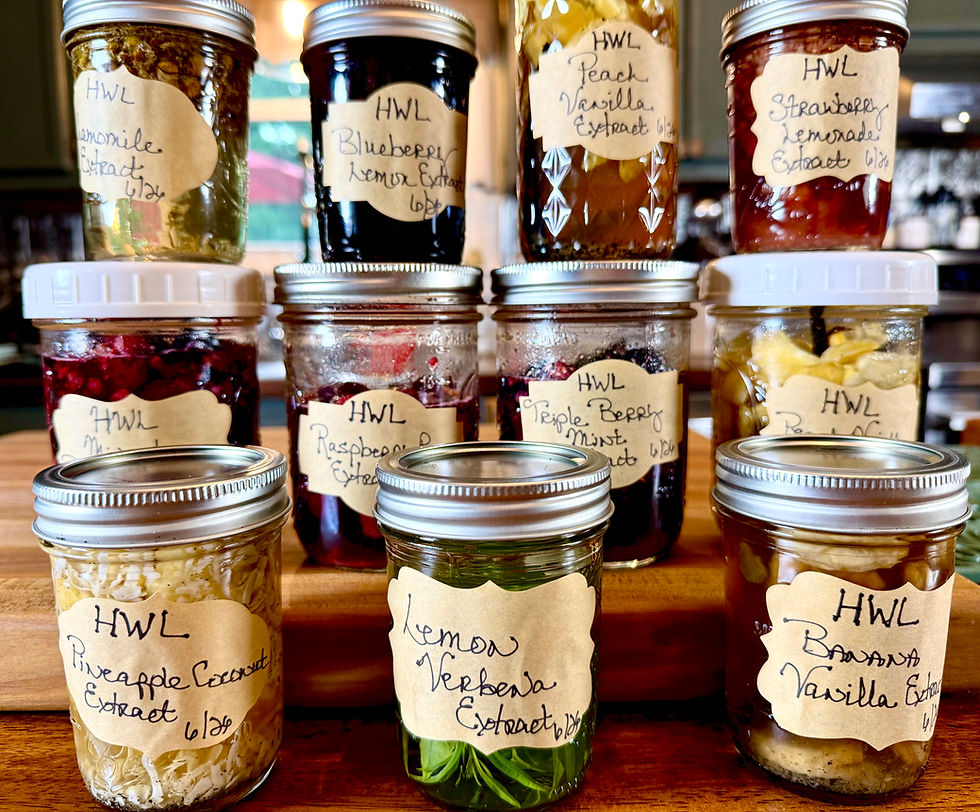
THE PRINTABLE IS LINKED AT THE BOTTOM OF THIS POST...
There is something deeply satisfying about opening a pantry and finding ingredients you created yourself.
Not because they saved money.
Not because they look pretty on the shelf.
But because they represent work already completed.
Today's effort becomes tomorrow's convenience.
That is exactly what homemade extracts do.
Most people think of extracts as simple baking ingredients. They certainly are. A splash of vanilla transforms a cake, and a bit of almond extract can completely change a cookie recipe. But extracts are also a form of preservation. We are capturing the flavors of a season and saving them for later.
When strawberries are abundant, we can preserve their flavor.
When peaches are sweet and fragrant, we can preserve their flavor.
When herbs are thriving in the garden, we can preserve their flavor.
The season may be temporary. The flavor does not have to be.
What Is a Flavor Larder?
Many homesteaders focus on preserving food.
We can tomatoes.
We dehydrate herbs.
We freeze vegetables.
We pressure can stocks.
Those are important skills.
But flavor deserves preservation too.
A flavor larder is a collection of ingredients that help create better food throughout the year. Homemade extracts, fruit powders, citrus sugars, infused vinegars, and infused oils all contribute to a kitchen that is prepared for more than just everyday meals.
A well-stocked flavor larder allows you to reach for strawberry in the middle of winter, peach long after harvest, or chamomile when the garden is sleeping beneath frost.
Freeze-Dried vs. Dehydrated Fruit
For this collection I primarily used freeze-dried fruit.
Freeze-dried fruit contains very little residual moisture, which makes it ideal for extract making. The concentrated flavor and low moisture content allow the alcohol to focus on extracting flavor rather than dealing with excess water.
Fully dehydrated fruit is also an excellent choice.
The important word is fully.
Do not focus on drying time.
Focus on texture.
During testing, some frozen fruit remained more moist than expected even after more than fourteen hours in the dehydrator. That experience reinforced an important lesson:
Watch the fruit, not the clock.
Different fruits contain different amounts of moisture, and humidity, tray placement, fruit thickness, and dehydrator performance all affect drying time.
The fruit should be as dry as your dehydrator can reasonably produce.
Choosing Your Spirit
The alcohol becomes part of the final flavor profile.
Vodka is ideal when you want the ingredient itself to remain the star. It contributes very little flavor and allows berries, flowers, and herbs to shine.
Dark rum contributes warmth, caramel notes, and complexity that pair beautifully with tropical fruits, peaches, and bananas.
For best results, use a spirit that is at least 80 proof (40% alcohol).
Building Your First Collection
If you are new to extract making, resist the temptation to make every jar immediately.
Start with three:
Strawberry Lemonade
Peach Vanilla
Chamomile
These three extracts demonstrate fruit, vanilla-based, and floral extraction techniques while providing a broad range of uses in the kitchen.
Once you become comfortable with the process, expand your collection.
There is no prize for making every extract at once.
A flavor larder is built over time.
How Long Should Extracts Age?
The most common question is also the simplest to answer.
Longer than you think.
Minimum aging time:
90 days
Better:
6 months
Excellent:
1 year or longer
The reward for patience is a smoother, richer, more complete flavor.
Future Uses
These extracts can be used in:
Cakes
Cookies
Buttercream
Cheesecake
Custards
Ice cream
Whipped cream
Pound cakes
Fruit fillings
Homemade gifts
A flavor larder should make everyday food more interesting, not just special occasion desserts.
Final Thoughts
This project is not really about extracts.
It is about preserving flavor.
Learning how to capture abundance while it exists changes the way you look at ingredients. Instead of asking, "How do I use this today?" you begin asking, "How can I save this for later?"
The answer may be an extract.
The answer may be a powder.
The answer may be a sugar, vinegar, or infused oil.
The method matters less than the mindset.
Good kitchen systems are built one project at a time.
Good pantries are built one ingredient at a time.
And a flavor larder is built one jar at a time.


I love making things from scratch everything tastes sooooo much better. My Grandmothers and Mother did everything homemade. I did make some vanilla extract it's wonderful! I would be interested in some of your recipes using these extracts if you don't mind, escpeially the Fioidi Di Sicilia